
A Tax Registered Company is a business that has completed the applicable tax registration process with the UAE Federal Tax Authority and has received a Tax Registration Number for the relevant tax.
Tax registration in the UAE is not a single procedure that applies identically to every business. A company may need to register for Corporate Tax, Value Added Tax, Excise Tax, or more than one tax, depending on its legal structure, activities, taxable income, revenue, imports, and taxable supplies.
Understanding whether a business qualifies as a Registered Tax Entity UAE is essential for company owners, investors, financial managers, accountants, and international entrepreneurs. Correct registration allows a business to submit tax returns, pay tax liabilities, issue compliant VAT invoices where applicable, and maintain proper records.
It is also important to distinguish tax registration from normal company formation. A company may hold a valid trade licence in the UAE but still need to complete separate registration procedures with the Federal Tax Authority.
This guide explains what a Tax Registered Company is, the different types of registration, the meaning of a Tax Registration Number, and the responsibilities businesses must follow after registration.
What Is a Tax Registered Company?
A Tax Registered Company is a legal entity that has registered with the UAE Federal Tax Authority, commonly known as the FTA, for one or more applicable taxes.
After a registration application is approved, the business receives a Tax Registration Number, or TRN. The number is used to identify the company in its tax records, applications, returns, payments, certificates, and communications with the FTA.
A company may be registered for:
- Corporate Tax.
- Value Added Tax.
- Excise Tax.
- More than one applicable UAE tax.
The type of registration depends on the company’s activities and legal obligations. Registration for one tax does not automatically mean the company is registered for every other tax.
For example, a business may be registered for Corporate Tax but may not yet meet the mandatory registration threshold for VAT.
Businesses seeking a broader understanding of the UAE taxation system can review LAWS’ guide to UAE Corporate Tax in Dubai.
What Is a Registered Tax Entity UAE?
The term Registered Tax Entity UAE generally refers to a person or legal entity that has successfully registered for an applicable UAE tax and received an official tax registration number.
A registered entity may include:
- A mainland limited liability company.
- A free zone company.
- A public or private joint-stock company.
- A branch of a foreign company.
- A foreign legal entity with a taxable presence in the UAE.
- A partnership or other recognised juridical person.
- A natural person conducting a qualifying business activity.
- A group of related companies registered as a tax group.
The registration obligations of each entity depend on its legal form, residency, activities, income, taxable supplies, and relationship with other businesses.
A Registered Tax Entity UAE must also ensure that the information registered with the FTA remains consistent with its trade licence and legal incorporation documents.
Tax Registration vs Company Registration in the UAE
Company registration and tax registration are related but separate legal and administrative procedures.
Company Registration
Company registration involves establishing the legal business entity and obtaining permission to conduct specified activities.
The company formation process may include:
- Reserving a trade name.
- Obtaining initial approval.
- Selecting a legal structure.
- Preparing the Memorandum of Association.
- Identifying shareholders and managers.
- Obtaining a commercial licence.
- Registering an office or business address.
- Receiving approvals from the relevant authorities.
A commercial licence may be issued by a mainland economic department or a UAE free zone authority.
Businesses should maintain accurate Corporate Legal Documentation in the UAE because the information provided during tax registration should match the company’s official records.
Tax Registration
Tax registration is completed separately through the Federal Tax Authority.
The purpose of tax registration is to identify the company within the applicable tax system and enable it to complete its filing, payment, record-keeping, and reporting obligations.
Therefore, holding a trade licence does not automatically confirm that the company has completed its Corporate Tax or VAT registration.
Companies should assess their tax position during the early stages of business establishment rather than waiting until a registration or filing deadline approaches.
Types of Tax Registration for UAE Companies
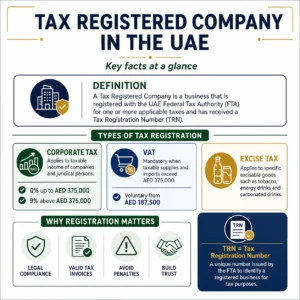
The most common tax registrations affecting companies in the UAE are Corporate Tax registration and VAT registration.
Depending on its business activities, a company may also be required to register for Excise Tax.
Corporate Tax Registration
Corporate Tax is a direct tax imposed on the taxable income of corporations and other businesses operating within the UAE tax framework.
The general UAE Corporate Tax rate is:
- 0% on taxable income up to AED 375,000.
- 9% on taxable income exceeding AED 375,000.
Registration and tax payment are two different matters. A company may be required to register for Corporate Tax even when its taxable income does not result in a Corporate Tax payment.
Taxable juridical persons are generally required to register with the Federal Tax Authority and obtain a Corporate Tax Registration Number.
According to the UAE Federal Tax Authority’s Corporate Tax Registration service, taxable persons must register and obtain a Corporate Tax Registration Number in accordance with the Corporate Tax legislation and the applicable executive decisions.
Businesses can review LAWS’ complete guide to Corporate Tax Registration UAE for a detailed explanation of the registration process, required documents, and common application mistakes.
Corporate Tax Registration Does Not Confirm Tax Payable
Receiving a Corporate Tax Registration Number does not automatically mean that a company must pay Corporate Tax at the 9% rate.
The final tax liability may depend on:
- The amount of taxable income.
- Available deductions.
- Applicable exemptions.
- Small Business Relief.
- Tax losses.
- Tax credits.
- Free zone classification.
- Qualifying and non-qualifying income.
- Transfer pricing adjustments.
The company must calculate its taxable income and submit the required Corporate Tax return even where the resulting tax liability is zero, unless a specific exemption or legal exception applies.
VAT Registration
VAT registration is separate from Corporate Tax registration.
It is mainly determined by the value of a business’s taxable supplies and imports, as well as whether the business is resident or non-resident.
Mandatory VAT Registration Threshold
A UAE-resident business must generally register for VAT when the total value of its taxable supplies and imports:
- Exceeded AED 375,000 during the previous 12 months; or
- Is expected to exceed AED 375,000 during the next 30 days.
Voluntary VAT Registration Threshold
A resident business may be eligible for voluntary VAT registration when the value of its taxable supplies, imports, or taxable expenses exceeds AED 187,500 during the relevant assessment period.
Non-resident businesses may be subject to different registration rules and may need to register without applying the standard mandatory threshold in certain circumstances.
The official FTA VAT Registration service allows eligible persons to apply for VAT registration and obtain a Tax Registration Number.
Businesses can also review LAWS’ detailed guide to VAT Registration UAE for information about thresholds, documentation, application steps, and ongoing VAT obligations.
Corporate Tax Registration vs VAT Registration
Corporate Tax and VAT are separate taxes with different registration requirements.
Corporate Tax is generally based on taxable business income. VAT generally applies to taxable supplies of goods and services.
A company may therefore be:
- Registered for Corporate Tax but not registered for VAT.
- Registered for VAT and Corporate Tax.
- Voluntarily registered for VAT.
- Required to register for VAT because it exceeded the mandatory threshold.
- Required to register for Excise Tax due to its products or activities.
Businesses should not assume that obtaining one TRN or completing one registration satisfies all tax obligations.
Each tax must be assessed separately based on the applicable legislation and the company’s circumstances.
Does Every UAE Company Need Tax Registration?
Not every company has the same tax registration obligations.
The need to register may depend on:
- The company’s legal form.
- Its UAE tax residency status.
- Its incorporation date.
- Its commercial activities.
- Its taxable income.
- Its annual revenue.
- The value of taxable supplies and imports.
- Mainland or free zone status.
- Whether it has a permanent establishment in the UAE.
- Whether an exemption applies.
- Whether it is part of a tax group.
- The particular tax being assessed.
Most taxable juridical persons are required to assess their Corporate Tax registration obligations.
VAT registration is normally determined by taxable supplies, imports, expenses, and residency conditions.
Professional advice may be especially important for:
- Foreign companies.
- Holding companies.
- Free zone companies.
- Companies with several branches.
- Partnerships.
- Businesses with related-party transactions.
- Companies operating across several jurisdictions.
- Businesses restructuring or changing ownership.
Do Free Zone Companies Need Tax Registration?
Establishing a company in a UAE free zone does not automatically remove its tax registration obligations.
A free zone company may still need to register for Corporate Tax and submit a Corporate Tax return.
A Qualifying Free Zone Person may benefit from a 0% Corporate Tax rate on qualifying income. However, the company must satisfy the applicable legal and regulatory requirements to maintain that treatment.
Relevant conditions may include:
- Maintaining adequate substance in the UAE.
- Deriving qualifying income.
- Complying with transfer pricing rules.
- Maintaining appropriate accounting records.
- Preparing audited financial statements where required.
- Meeting de minimis requirements.
- Avoiding activities that may affect qualifying status.
- Filing the required Corporate Tax return.
A 0% rate does not automatically mean that the company is exempt from registration, return filing, financial reporting, or record-keeping.
Businesses operating in free zones can review LAWS’ guide to Free Zone Corporate Tax in Dubai before relying on a particular tax treatment.
How to Register a Company for Tax in the UAE
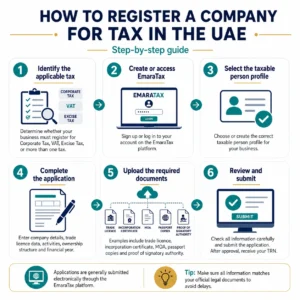
Tax registration applications are generally submitted electronically through the EmaraTax platform.
The exact application steps and required documents depend on whether the business is registering for Corporate Tax, VAT, Excise Tax, or a tax group.
Digital tax registration reflects a broader international shift toward technology-based tax administration. According to the OECD’s guidance on the digital transformation of tax administration, digital systems can simplify taxpayer interactions, reduce administrative burdens, improve accuracy, and make tax compliance more efficient for businesses.
Before starting the application, the company should identify the applicable tax, create or access its EmaraTax account, select the correct taxable person profile, prepare the required documents, and ensure that all information matches its trade licence and official incorporation records.
Step 1: Identify the Applicable Tax
The first step is to determine which registration applies to the company.
The company should assess whether it is required to register for:
- Corporate Tax.
- VAT.
- Excise Tax.
- More than one tax.
The assessment should not be based only on the business’s expected profits. Registration may depend on the legal structure, annual revenue, taxable supplies, imports, residency, or specific activities.
Step 2: Create or Access an EmaraTax Account
The authorised person must create an EmaraTax account or access an existing account.
Companies that have already registered for VAT or Excise Tax may use their existing account to access other tax services.
Step 3: Create or Select the Taxable Person Profile
The applicant must create or select the correct taxable person profile.
Care should be taken when the business owner operates:
- Several companies.
- Multiple branches.
- More than one sole establishment.
- A group of related companies.
- Businesses under different trade licences.
Submitting a registration application under the wrong profile may result in delays or inaccurate tax records.
Step 4: Complete the Registration Application
The company may need to provide information including:
- Legal name.
- Trade name.
- Legal form.
- Incorporation date.
- Trade licence details.
- Business activities.
- Registered address.
- Ownership structure.
- Details of managers and authorised signatories.
- Financial year.
- Contact information.
All information should be consistent with the official trade licence and incorporation documents.
Step 5: Upload the Required Documents
Documents required for registration may include:
- Certificate of incorporation.
- Memorandum of Association.
- Articles of Association.
- Partnership agreement.
- Commercial registration certificate.
- Valid trade licence.
- Branch licences where applicable.
- Passport copies.
- Emirates ID copies.
- Documents proving the authority of the authorised signatory.
- Financial or turnover evidence for VAT registration.
- Contracts, purchase orders, or invoices supporting expected revenue.
The FTA may request additional documentation depending on the entity’s legal form and application.
Step 6: Review and Submit the Application
The applicant should carefully review the information before submission.
Errors in company names, licence numbers, financial periods, ownership details, or uploaded documents may delay approval.
After submission, the FTA may:
- Approve the application.
- Request additional documents.
- Ask the applicant to correct information.
- Seek clarification about activities or ownership.
- Reject an incomplete or unsupported application.
Step 7: Receive the Tax Registration Number
Once the application is approved, the business receives its Tax Registration Number or relevant tax registration certificate through its EmaraTax account.
The company should confirm that the legal name and registered details shown on the certificate are accurate.
What Is a Tax Registration Number?
A Tax Registration Number is a unique number issued by the Federal Tax Authority to a person registered for tax purposes.
The FTA defines a Tax Registration Number as a unique number issued by the Authority to each person registered for tax.
A TRN may be used for:
- Identifying the company in the UAE tax system.
- Submitting tax returns.
- Making tax payments.
- Communicating with the FTA.
- Issuing compliant VAT invoices.
- Accessing tax certificates.
- Updating registration information.
- Supporting commercial due diligence.
- Managing tax account records.
The company should ensure that access to its EmaraTax account is restricted to authorised employees, legal representatives, accountants, or approved tax professionals.
Is a Trade Licence Number the Same as a TRN?
No. A trade licence number is not the same as a Tax Registration Number.
A trade licence number is issued by the relevant mainland or free zone licensing authority. It confirms that the company is authorised to conduct specified commercial activities.
A TRN is issued by the Federal Tax Authority and identifies the business for the applicable tax.
Companies should not:
- Use their trade licence number as a VAT TRN.
- Describe themselves as VAT registered before approval.
- Add an invalid or unrelated TRN to tax invoices.
- Use the TRN of another company or related entity.
- Assume that branches always require separate registrations.
The legal entity shown on the tax certificate should match the entity issuing the relevant tax invoice or filing the return.
Responsibilities of a Tax Registered Company
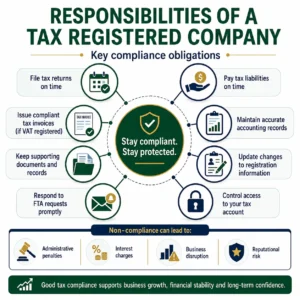
Tax registration is the beginning of the compliance process rather than its conclusion.
After becoming a Tax Registered Company, the business may need to:
- Maintain accurate accounting records.
- File tax returns by the applicable deadlines.
- Pay tax liabilities on time.
- Issue compliant tax invoices.
- Maintain supporting documents.
- Reconcile accounting and tax records.
- Update changes to registration information.
- Respond to FTA requests.
- Correct errors in previous returns.
- Support deductions and input VAT recovery.
- Apply for deregistration when the legal conditions are met.
Companies should establish a tax compliance calendar that covers:
- Registration deadlines.
- Tax return deadlines.
- Tax payment dates.
- Financial year-end dates.
- Licence renewal dates.
- Financial statement preparation.
- Document-retention periods.
- Registration amendment requirements.
Businesses can review LAWS’ guide to UAE Corporate Tax Compliance for practical information about tax registration, accounting records, return filing, and ongoing compliance.
Corporate Tax Return Filing
Corporate Tax returns and applicable tax payments are generally due within nine months from the end of the relevant tax period.
The company should prepare its financial and tax records well before the filing deadline.
Corporate Tax compliance may require the business to review:
- Accounting income.
- Deductible and non-deductible expenses.
- Exempt income.
- Related-party transactions.
- Transfer pricing documentation.
- Tax losses.
- Tax credits.
- Interest deduction restrictions.
- Free zone income classifications.
- Elections and available reliefs.
The taxable person remains responsible for the accuracy of the return even when an external accountant, consultant, or tax agent assists with its preparation.
VAT Obligations After Registration
After VAT registration, a business may need to:
- Charge VAT on taxable supplies.
- Issue compliant tax invoices.
- File VAT returns for the assigned tax period.
- Pay net VAT liabilities.
- Maintain sales and purchase records.
- Retain valid tax invoices.
- Review the eligibility of input VAT recovery.
- Issue tax credit notes when required.
- Update changes to registered information.
- Apply for deregistration when the legal requirements are satisfied.
VAT should not be charged before the business is legally registered and authorised to do so.
The company should also verify the tax treatment of each transaction rather than assuming that every sale is subject to the standard VAT rate.
Common Mistakes Made by Tax Registered Companies
Confusing Corporate Tax With VAT
Corporate Tax and VAT have different scopes, calculations, filing procedures, and registration requirements.
Completing one registration does not automatically satisfy the other.
Assuming a 0% Rate Means No Registration
A business may still need to register and file returns even when no tax is payable.
This is particularly relevant to qualifying free zone companies and companies whose taxable income falls within the 0% band.
Submitting Incorrect Company Information
Differences between the application, trade licence, incorporation certificate, and shareholder documents may cause delays.
Registering the Wrong Legal Entity
A company group may contain several separate legal entities. Each entity’s registration position must be assessed correctly.
Missing Registration Deadlines
Late Corporate Tax registration may result in an administrative penalty of AED 10,000, subject to any current waiver initiative and its eligibility conditions.
Companies that are concerned about late registration or filing should review LAWS’ guide to UAE Corporate Tax Penalties.
Failing to Update Registered Information
Changes in ownership, licence details, activities, address, legal structure, manager, or authorised signatory may need to be reported to the FTA.
Poor Accounting Records
Incomplete records can make it difficult to calculate taxable income, prepare tax returns, recover input VAT, or respond to an FTA review.
Using an Incorrect TRN
Using the wrong TRN on invoices can create problems for both the supplier and the customer, especially where the customer intends to recover input VAT.
How to Check Whether a Company Is Tax Registered
A company can review its own registration status through its EmaraTax dashboard and tax registration certificate.
When conducting due diligence on another business, a company may request:
- A copy of the tax registration certificate.
- The company’s trade licence.
- Confirmation of the registered legal name.
- The TRN shown on the tax invoice.
- Evidence that the certificate relates to the contracting entity.
The legal name on the tax registration certificate should correspond with the entity entering the transaction.
However, possession of a TRN alone does not prove that:
- Every transaction is subject to VAT.
- The company has filed all returns.
- The company has paid all tax liabilities.
- The tax treatment shown on an invoice is correct.
- The business is registered for every applicable tax.
The underlying transaction and its tax treatment must still be reviewed.
Benefits of Proper Tax Registration
Maintaining correct registration and ongoing compliance may help a business:
- Operate within the UAE tax framework.
- Avoid registration and filing penalties.
- Issue valid VAT invoices where applicable.
- Recover eligible input VAT.
- Maintain reliable financial records.
- Support audits and due diligence.
- Improve relationships with investors and banks.
- Prepare for mergers and acquisitions.
- Support business restructuring.
- Protect its commercial reputation.
- Make informed financial decisions.
Tax compliance is particularly important when a company is seeking finance, attracting investment, selling its business, restructuring ownership, or entering major commercial agreements.
When Should a Company Seek Professional Tax Support?
A company should consider professional assistance when:
- It is uncertain whether registration is mandatory.
- Its revenue is approaching the VAT threshold.
- It has missed a registration deadline.
- It has received an FTA notification.
- It operates in a UAE free zone.
- It has several branches or legal entities.
- It conducts cross-border transactions.
- It has foreign shareholders.
- It has related-party transactions.
- It wants to establish a tax group.
- It needs to correct a previous tax return.
- It is restructuring, merging, or closing.
- It is applying for deregistration.
- Its accounting records are incomplete.
Professional advisors can help the company identify the correct taxable person, assess registration obligations, prepare supporting documentation, and maintain ongoing compliance.
Companies requiring broader legal and regulatory support can explore LAWS’ Business Legal Advisory services.
Tax Registered Company Compliance Checklist
A Registered Tax Entity UAE should regularly confirm that:
- The correct legal entity is registered.
- Registration details match the trade licence.
- Corporate Tax and VAT have been assessed separately.
- The correct TRN is being used.
- Accounting records are complete.
- Tax invoices contain the required details.
- Filing deadlines are recorded.
- Tax payments are submitted on time.
- Supporting documents are retained.
- Business changes are reported when required.
- FTA correspondence is reviewed promptly.
- Access to the tax account is properly controlled.
- Deregistration requirements are considered when activities stop.
Periodic compliance reviews can help identify errors before they result in penalties, rejected claims, or tax disputes.
Frequently Asked Questions
What does Tax Registered Company mean in the UAE?
A Tax Registered Company is a company that has registered with the Federal Tax Authority for an applicable UAE tax and received the relevant Tax Registration Number.
Is every UAE company VAT registered?
No. VAT registration generally depends on the value of taxable supplies and imports, the applicable threshold, and whether the business is resident or non-resident.
Must every UAE company register for Corporate Tax?
Taxable juridical persons are generally required to assess and complete their Corporate Tax registration obligations. Specific exemptions and rules may apply depending on the entity.
Can a company register for Corporate Tax without registering for VAT?
Yes. Corporate Tax and VAT have separate registration requirements. A company may be registered for Corporate Tax without meeting the mandatory or voluntary VAT registration threshold.
Does a free zone company need tax registration?
A free zone company may be required to register for Corporate Tax and may also need VAT registration if it meets the applicable conditions.
Is a trade licence a tax registration certificate?
No. A trade licence authorises the company to conduct specified activities. A tax registration certificate confirms its registration with the Federal Tax Authority for a particular tax.
What is the difference between a TRN and a trade licence number?
A TRN identifies a person for tax purposes, while a trade licence number identifies the business licence issued by the relevant licensing authority.
Can a company charge VAT without a VAT TRN?
A company should not charge VAT unless it has completed the applicable VAT registration process and is legally authorised to charge the tax.
What happens after a company receives its TRN?
The company must continue complying with its return filing, payment, invoicing, accounting, record-keeping, and registration-update obligations.
Can a Tax Registered Company be deregistered?
Yes. A company may apply for tax deregistration when it meets the applicable legal conditions, such as ceasing business activities or no longer meeting registration requirements.
Conclusion
A Tax Registered Company is a business that has formally entered the UAE tax system by completing the appropriate registration process with the Federal Tax Authority.
However, becoming a Registered Tax Entity UAE involves more than obtaining a TRN. The company must identify which taxes apply, register the correct legal entity, maintain accurate accounting records, submit returns, pay tax liabilities, update its information, and retain supporting documentation.
Corporate Tax, VAT, free zone rules, foreign ownership, and cross-border activities can affect each company differently. Businesses should therefore assess their obligations based on their individual legal structure and commercial activities.
Early registration, accurate documentation, and ongoing compliance can help a company avoid penalties, protect its operations, and maintain a strong regulatory position in the UAE.
Need Assistance With Tax Registration in the UAE?
LAWS supports UAE and international businesses with Corporate Tax registration, VAT registration, company structuring, corporate documentation, and ongoing legal and regulatory compliance.
Our team can review your company’s legal structure, determine the applicable tax registration requirements, prepare supporting documents, and assist with maintaining accurate tax records.
Contact LAWS to discuss the tax registration and compliance requirements affecting your business in the UAE.