Table of Contents
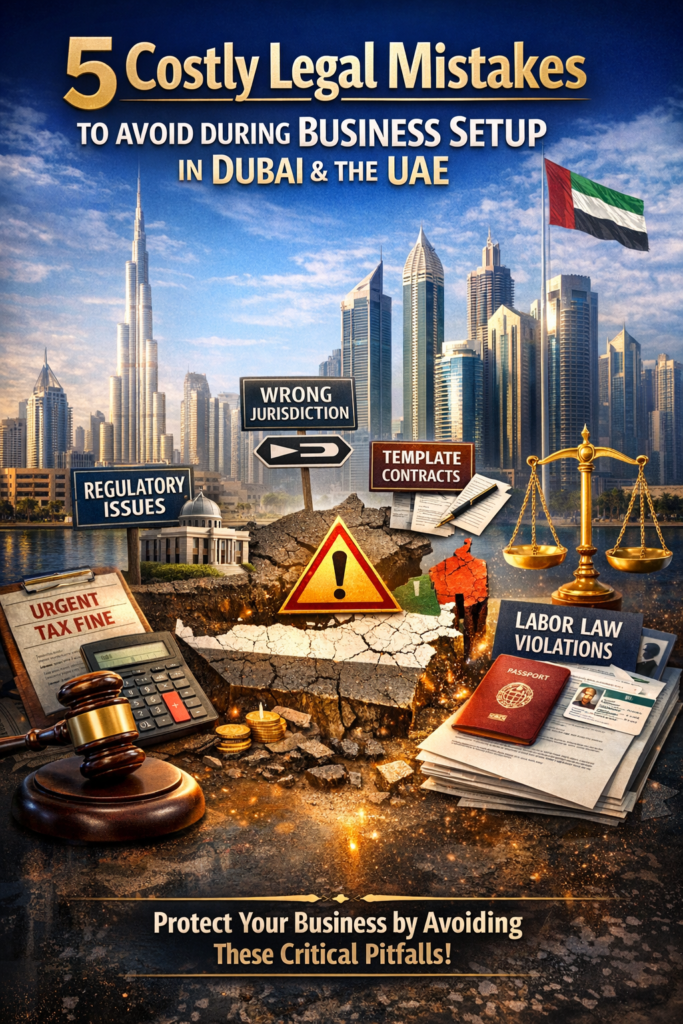
5 Costly Legal Mistakes to Avoid During Business Setup in Dubai & the UAE
Introduction When planning a Business Setup in Dubai, many entrepreneurs focus on growth but overlook critical legal details that can determine their long-term success. The United Arab Emirates, particularly Dubai, is a world-class hub for global investors. While the government has significantly streamlined the registration process, the enthusiasm to launch can sometimes cause business owners to ignore the fine print of the law.
Failing to establish a solid legal foundation can lead to hefty fines, operational restrictions, or disputes that could threaten your company’s future. To help you navigate the UAE corporate landscape safely, here are five common legal mistakes investors make—and how to avoid them.
1. Choosing the Wrong Legal Jurisdiction
One of the most frequent—and expensive—mistakes new investors make is selecting a jurisdiction based solely on the initial setup cost rather than their long-term business model.
Many entrepreneurs rush to set up in a Free Zone because it seems easier, only to realize later that they legally cannot trade directly within the local UAE market without a local distributor. Conversely, setting up a Mainland company when you only intend to export internationally might subject you to unnecessary regulatory requirements.
- The Solution: Evaluate your target audience and operational scope carefully. Before making a decision, we highly recommend reading our comprehensive legal comparison on Mainland vs Freezone in the UAE to ensure you choose the exact right fit for your business goals.
2. Relying on Standard “Template” Contracts
The Memorandum of Association (MoA) is the constitution of your company. Many business partners make the mistake of using standard, generic templates provided by typing centers or initial approval authorities just to save time.
These templates rarely cover specific scenarios like dispute resolution, precise profit-sharing arrangements, intellectual property protection, or exit strategies.
- The Solution: Always have a specialized corporate lawyer draft or thoroughly review your MoA and Shareholders’ Agreement. Customizing these documents to align with the latest UAE Commercial Companies Law is non-negotiable for protecting your rights.
3. Overlooking External Approvals and Regulatory Compliance
Getting your primary trade license from the Department of Economy and Tourism (DET) or a Free Zone authority is only the first step. A major pitfall for many investors is the “license-first, research-later” approach, assuming that a general commercial license covers all operational activities. In the UAE, specialized industries are governed by strict sectoral regulators.
Activities in sectors like healthcare, education, food and beverage, or fintech require additional “external approvals” from specific government bodies. For instance, a medical clinic requires DHA (Dubai Health Authority) approval, an education center needs KHDA (Knowledge and Human Development Authority) clearance, and any financial service must be vetted by the Central Bank or the DFSA. Operating without these specific permits—even with a valid trade license—can lead to immediate business suspension and heavy administrative fines.
- The Solution: Before signing long-term office leases or hiring staff, conduct a thorough regulatory mapping of your specific niche. You can check the official UAE Government guidelines on business activities to verify which secondary approvals apply to your business category.
4. Misunderstanding the Evolution of UAE Corporate Tax Laws
The UAE’s tax landscape has shifted from a tax-free haven to a regulated, transparent tax jurisdiction. With the introduction of the Federal Corporate Tax at a standard rate of 9% for taxable income exceeding AED 375,000, financial compliance is no longer optional. A dangerous misconception among new entrepreneurs is that tax laws only apply to large corporations.
In reality, ignorance of these laws is not an accepted legal defense. Even if your company is set up in a Free Zone and potentially qualifies for a 0% tax rate as a “Qualifying Free Zone Person,” the legal obligations remain high. You are still strictly required to register for Corporate Tax with the Federal Tax Authority (FTA), maintain internationally compliant audited financial records, and file an annual tax return within the prescribed deadlines. Failure to register or late filing can result in penalties that significantly drain your startup capital.
- The Solution: Integrate professional accounting and legal tax compliance into your business structure from day one. Ensure your bookkeeping meets IFRS standards to simplify your annual tax filings and avoid “Red Flags” during FTA audits.
5. Ignoring New Labor Laws and Visa Regulations
The UAE recently overhauled its labor regulations with Federal Decree-Law No. 33 of 2021. Drafting employment contracts that do not strictly adhere to this updated UAE Labour Law is a common legal trap. Many companies still use outdated contract clauses regarding notice periods or non-compete agreements that are no longer enforceable in UAE courts.
Beyond contracts, businesses often fail to provide mandatory benefits like the Involuntary Loss of Employment (ILOE) insurance or mishandle the visa sponsorship process. Errors in the Work Permit application or failing to cancel visas properly can lead to labor disputes, “Absconding” cases, and even a “Block” on the company’s file by the Ministry of Human Resources and Emiratisation (MOHRE), preventing you from hiring any further staff.
- The Solution: Ensure all employment contracts are digitized and drafted in accordance with the latest MOHRE decrees. Contracts must clearly outline probation periods (which cannot exceed 6 months), termination clauses, and accurate end-of-service gratuity calculations to protect the company from future litigation.
Conclusion
Setting up a business in Dubai and the wider UAE offers incredible opportunities and a gateway to global markets, provided it is built on a legally sound foundation. The complexity of the UAE’s legal ecosystem means that “Standard” is rarely enough. By taking the time to understand the specific jurisdictional requirements, avoiding generic contract templates, and staying ahead of tax and labor reforms, you ensure your venture is built on a compliant, secure, and highly profitable foundation.
If you want to dive deeper into the overarching legal frameworks and the specific steps for registration, make sure to explore our complete guide on Business Setup & Corporate Law in Dubai to stay fully informed.